The catalogue of free audio software in 2026 is larger and better than most paid stacks were a decade ago. The problem is no longer scarcity, it is sprawl — thirty installers, no workflow, and a folder of demos that expire.
Start from the signal chain, not the download list
You need one of each: a DAW, a corrective EQ, a compressor, a saturator, a reverb, a delay, a metering plugin, and a way to deliver files. That is eight decisions. Anything beyond that list is a preference, not a requirement, and can wait until a specific project demands it.
Rules for choosing a free tool
- It must have documentation. An undocumented plugin is a plugin you will use at 30% of its capability.
- It must be maintained. Check the last release date before installing; an abandoned plugin becomes a broken session in two OS updates.
- It must have a stated license. "Free download" is not a license; know whether commercial use is permitted.
- It must install cleanly and uninstall cleanly. Anything requiring an account manager for a free product costs more than it gives.
Learn one tool completely before adding another
Skill transfers between plugins far better than presets do. A producer who genuinely understands one EQ — filter slopes, Q behaviour, phase response, where it hurts — will get more out of any other EQ they touch. That is why AOS ships each of its tools with a course rather than a preset pack.
Where AOS fits
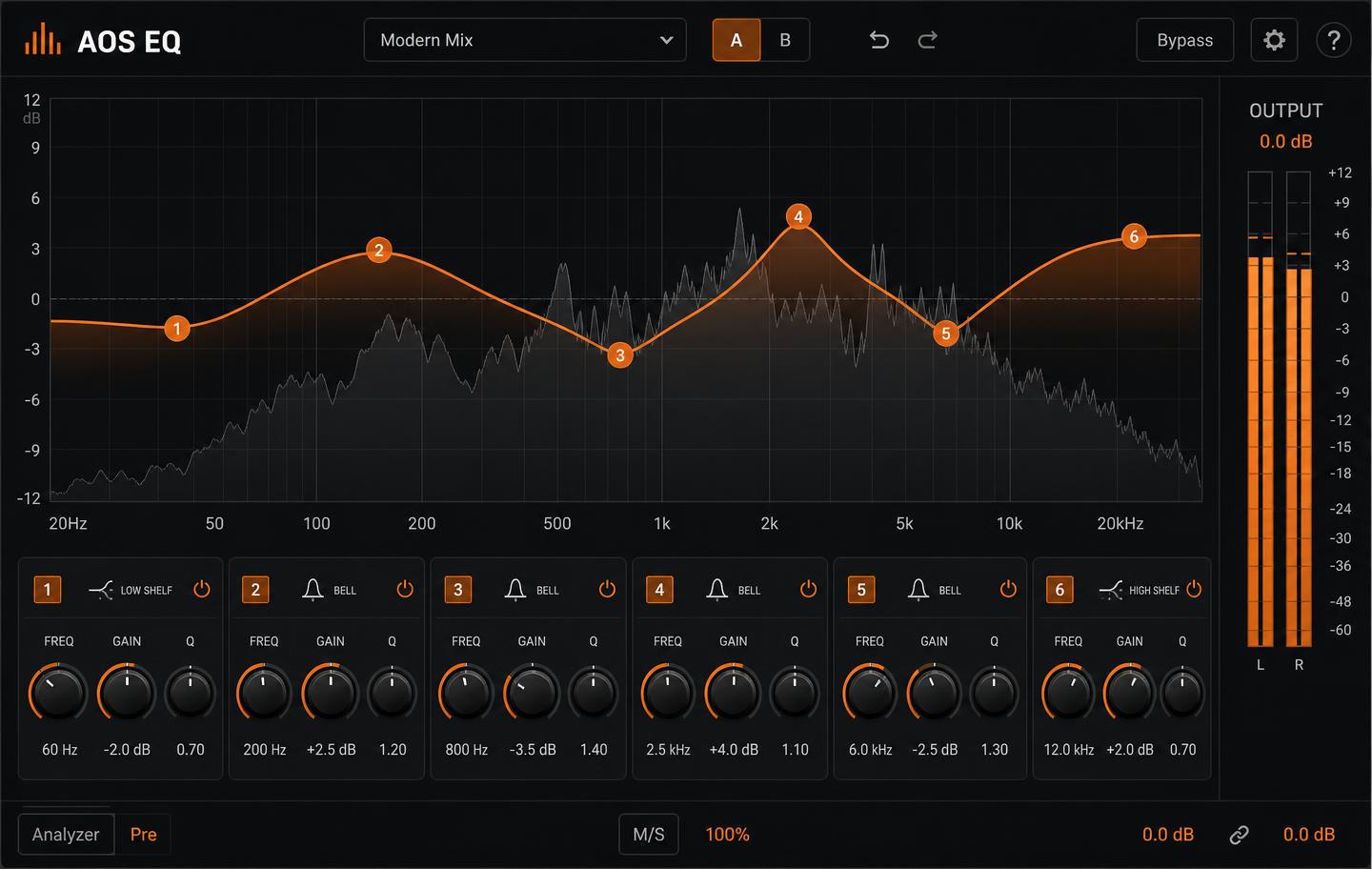
AOS EQ and AOS Reverb are being built to the same standard we would want from anything we install: documented, licensed for commercial use, no account required, and paired with free instruction. Both are in development and open for the waitlist. Everything we release stays free, permanently, because the point of the organisation is to remove cost from practice.